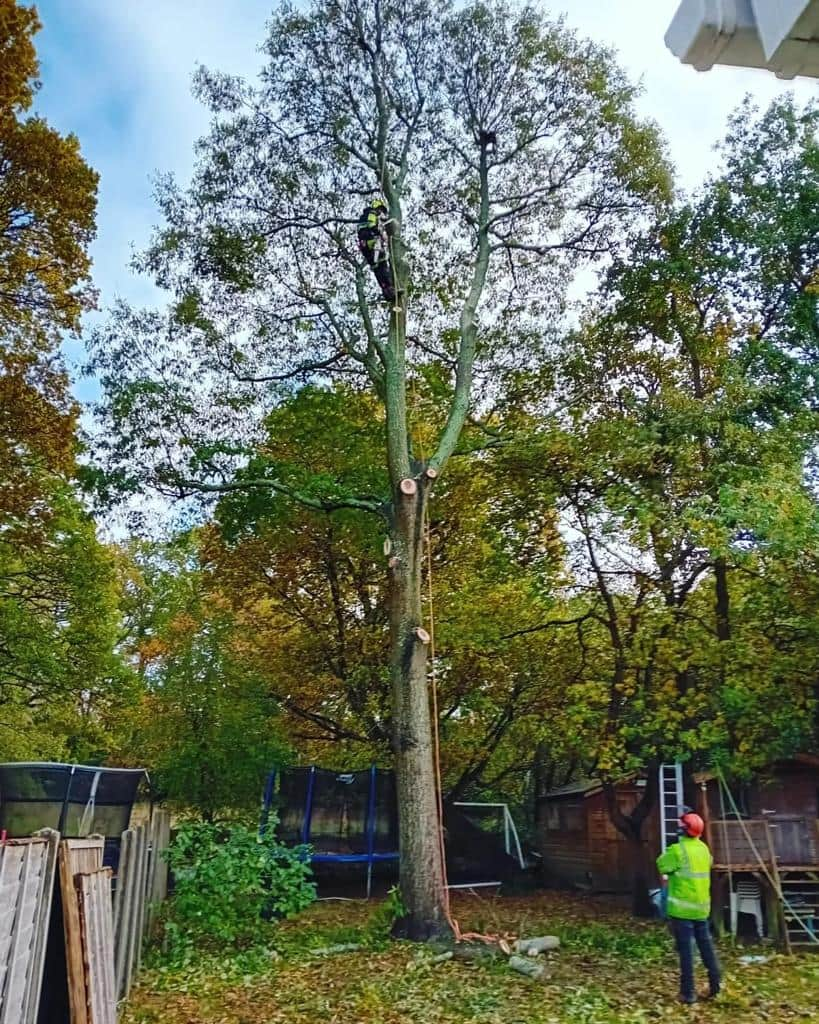
Crown reduction is a specialist tree surgery technique used to decrease the height, spread or overall volume of a tree’s canopy. It may be recommended when a crown has become too large for its surroundings, particular limbs are carrying excessive weight, or a mature tree needs careful management without removing it.
Effective crown reduction is not achieved by cutting every branch back to the same point. Each cut must be selected according to the tree’s structure, species, condition and natural growth pattern. For tree owners in Tewkesbury, Gloucestershire, this precision is essential for producing a balanced result while protecting the tree’s long-term health.
How Selective Cutting Protects the Tree and Its Structure
The purpose of crown reduction is to retain a smaller version of the tree’s natural canopy. A skilled tree surgeon examines how the main limbs divide, where suitable lateral branches are positioned and how much foliage can reasonably be removed.
Cuts Must Be Made at Suitable Growth Points
Branches should normally be shortened to healthy lateral growth points capable of continuing the natural flow of the limb. The remaining lateral branch needs to be sufficiently strong and well positioned to assume the role of the removed section.
Cutting between growth points can leave long stubs that may die back. Cutting too close to the main stem or branch collar can also interfere with the tree’s natural response to pruning.
Precise positioning helps the tree manage each wound and directs future growth into retained branches.
The Natural Crown Shape Should Be Retained
Different species have distinct forms. Some develop broad, spreading canopies, while others grow with a narrower or more upright habit. Crown reduction should respect these characteristics rather than forcing every tree into a uniform outline.
Selective pruning allows the outer canopy to be reduced while maintaining a natural branch structure. The finished tree should appear proportionate and balanced from different viewpoints, not simply smaller from the ground.
Excessive Foliage Removal Can Weaken the Tree
Leaves produce the energy a tree needs for growth, defence and recovery. Removing too much of the crown at once can significantly reduce its ability to sustain itself.
A professional assessment considers the percentage of foliage that can be removed without placing unnecessary stress on the tree. This varies according to species, maturity, vitality and growing conditions.
Older or declining trees may tolerate less pruning than vigorous young specimens. In some cases, a staged approach may be more appropriate than attempting a substantial reduction in one operation.
Branch Weight Must Be Reduced Evenly
One reason for reducing a crown is to lessen the leverage placed on long or heavily extended limbs. However, removing weight unevenly can create imbalance within the canopy.
Selective cutting distributes the reduction across relevant parts of the crown while preserving adequate foliage and structural support. Particular attention may be given to overextended branches, weak unions and areas with excessive end weight.
This requires an understanding of how each limb contributes to the tree’s overall stability rather than simply removing the longest visible growth.
Wound Size Needs Careful Control
Large pruning wounds take longer for a tree to manage than smaller cuts. They also expose a greater area of internal wood. Wherever possible, crown reduction should be achieved through numerous carefully chosen cuts towards the outer canopy instead of removing major limbs unnecessarily.
Planning the reduction before cutting begins helps preserve the main framework and limit wound size. This is particularly important for mature trees, where large structural branches may have developed over many years.
Poor Cutting Can Produce Weak Regrowth
Indiscriminate cutting, sometimes called topping, removes branches without regard for suitable growth points or natural structure. This can trigger clusters of vigorous new shoots close to the wounds.
These shoots may be weakly attached and can create a dense, poorly organised canopy. The tree may quickly regain height while developing new maintenance concerns.
Selective crown reduction encourages more controlled growth from retained branches. Although future pruning may still be necessary, the response is generally easier to manage when the original work has respected the tree’s structure.
Every Part of the Crown Reacts Differently
Branches do not grow at the same rate or carry equal loads. The upper crown may be more exposed to wind, one side may extend towards a building, and lower limbs may be shaded by surrounding growth.
A uniform reduction would not account for these differences. Tree surgeons assess each part of the canopy individually, deciding where more or less growth should be removed to achieve the required outcome.
The final specification may include reductions measured in branch length, crown spread or canopy volume, depending on the tree and the reason for the work.
Species and Condition Influence the Approach
Tree species differ in how they respond to pruning. Their growth habits, wood strength and ability to manage wounds all affect where cuts should be made and how much crown can be removed.
The tree’s current condition is equally important. Signs such as decay, deadwood, weak unions, previous pruning and uneven growth may change the reduction plan.
A professional inspection allows the work to be tailored to the individual tree instead of applying a standard method.
What a Professional Assessment Should Consider
Before crown reduction begins, the assessment should examine:
- The tree’s species, age and vitality
- Its natural crown shape and branch arrangement
- The reason for reducing the canopy
- Long or heavily weighted limbs
- Weak, damaged or crossing branches
- The position of suitable lateral growth points
- The amount of foliage that can be retained
- How the tree is likely to respond after pruning
These factors allow the reduction to be planned around both the required clearance and the tree’s continuing health.
Crown Reduction Is Different From General Trimming
General trimming often focuses on small outer growth or routine canopy maintenance. Crown reduction involves a more deliberate alteration of the tree’s dimensions and load distribution.
It requires decisions about branch hierarchy, wound placement, retained foliage and future growth. This is why the work should be based on a clear specification rather than carried out as a broad cut-back.
Conclusion
Crown reduction requires precise and selective cutting because every branch removed affects the tree’s balance, energy reserves and future development. Correct cuts at suitable lateral growth points help retain the natural crown shape, limit wound size and reduce the likelihood of weak, uncontrolled regrowth.
EM Tree Surgery Tewkesbury provides professional crown reduction and tree surgery services in Tewkesbury, Gloucestershire. If a tree has become too large or contains overextended branches, contact our team to arrange an assessment and determine an appropriate pruning approach.
Call us on: 01684 215 889
Click here to find out more about EM Tree Surgery Tewkesbury
Click here to complete our contact form and see how we can help with your trees needs.